Events in northern and eastern Syria have escalated repeatedly in recent weeks. Following the talks in Paris on January 5 between the Syrian transitional government and Israel, Turkey, and apparently also an US-delegation, attacks on the Kurdish neighborhoods in Aleppo followed, and shortly thereafter a larger wave of attacks on the self-administration areas. Under pressure from the imperialist and regional major powers, a ceasefire agreement was finally reached on January 30 between the self-administration and the transitional government.
At this point, it is not possible to predict how the agreement will be implemented in detail, many points are still not included or clarified. However, we would like to note here how it came about in the first place. It is the experience of years of resistance within the revolutionary people’s war that has enabled the self-administration to oppose, within the limits of what was possible, the united front from Jolani through Turkey to the USA, to prevent massacres of the population, and to secure significant weight at the negotiating table. It is also important to mention the great resistance in the streets worldwide, which within a very short time was able to mobilize tens of thousands of people for demonstrations and actions, thereby contributing its share to the leverage in the negotiations. .
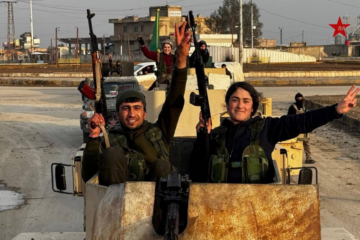
Despite repeatedly reaffirmed willingness to engage in talks and the declaration of countless ceasefires, the military forces of the new Syrian regime (HTS) and its allies, the Turkish-controlled militias (SNA), were able to push the front line as far as Kobanê and Hesekê. Kobanê was encircled, and to the north of the city, along the Turkish border, the Turkish military meanwhile positioned itself with tanks in preparation for intervention.
The offensive of the jihadist militias and their allies would not have been possible without the consent, or at least the approval, of the United States, as well as the regional powers Turkey and Israel. The European Union is also playing its role and was already on the scene to pledge support of 620 million euros to the new Syrian regime, while the massacres in Aleppo were still ongoing.
How are these events to be assessed from a revolutionary perspective, from within the metropoles? It becomes absolutely clear that the struggle for the Revolution of Rojava is not being fought only in the Middle East. The responsible imperialist forces can also be found here among us, in our own country. Switzerland, too, sent two delegations to Damascus as early as January in order to deepen trade relations.
At the same time, it must be acknowledged that the revolutionary process in Rojava, however threatened it may be, has already created irreversible realities. The force that the women’s revolution has unleashed worldwide cannot be undone. The realization that one must rely on and trust in one’s own strength cannot be forgotten. It is these achievements of the revolution that must be defended and highlighted. For within a revolutionary process that extends over a long historical period, it is of central importance to trace and not lose the thread of continuity. The strength of the revolutionary people’s war in Rojava is defined precisely by the fact that this thread has been continuously developed through the most diverse, complex, and difficult phases and continues to be developed today.
What does the line of revolutionary internationalism look like in these times? It is important not to lose oneself on secondary fronts, but to maintain and further develop the continuity of one’s own line and practice. This means continuing to name the enemy within one’s own country, attempting to link international solidarity with the revolutionary process within one’s own country, and thereby on the one hand indirectly giving comrades breathing space, and on the other hand advancing the revolutionary process at home.
Let us close ranks in support of the resistance in Rojava, organize ourselves here, and deny the enemy any peaceful rear base.
For revolutionary internationalism !
Smash Turkish Fascism !
Widerstandsvernetzung Switzerland, 15. February 2026